
Choose Your Spoken Arabic
Modern Standard Arabic unites the Arab world in writing — but people speak in regional dialects. Pick the one that matches where you'll travel, work, or build relationships.
Egyptian Arabic (Masri) is the most widely understood spoken dialect thanks to decades of Egyptian cinema, TV, and music. If you want maximum reach across the Arab world from a single dialect, this is the pragmatic choice.
Signature features
- ج pronounced as a hard g (gamal instead of jamal)
- ق often softened to a glottal stop
- Playful, rhythmic intonation with distinctive question tags
Common phrases
Levantine (Shami) is the smooth, musical dialect of the eastern Mediterranean. Widely used in pan-Arab pop music and soap operas, it sits closer to MSA than Egyptian in pronunciation, which many learners find easier to transition into.
Signature features
- ق dropped to a glottal stop in urban speech ('ahwe for coffee)
- Softer vowels, melodic cadence
- Polite forms and hospitality vocabulary are rich and essential
Common phrases
Gulf Arabic (Khaleeji) is the dialect of the Arabian Peninsula. It retains more classical features than Egyptian or Levantine — essential for anyone working in Saudi Arabia, the UAE, or across Gulf business and government.
Signature features
- ق pronounced as g (gahwa for coffee)
- ك often softened to ch before front vowels
- Formal registers are used widely in business and media
Common phrases
Sham Arabic (Shami) is the urban speech of Damascus and nearby cities. It's clear, melodic, and often chosen by learners who want a practical dialect for Syria and Levant communities abroad.
Signature features
- Frequent use of b- in the present tense (baktob — I write)
- Urban pronunciation often softens ق to a glottal stop
- Everyday expressions emphasize warmth, respect, and social closeness
Common phrases
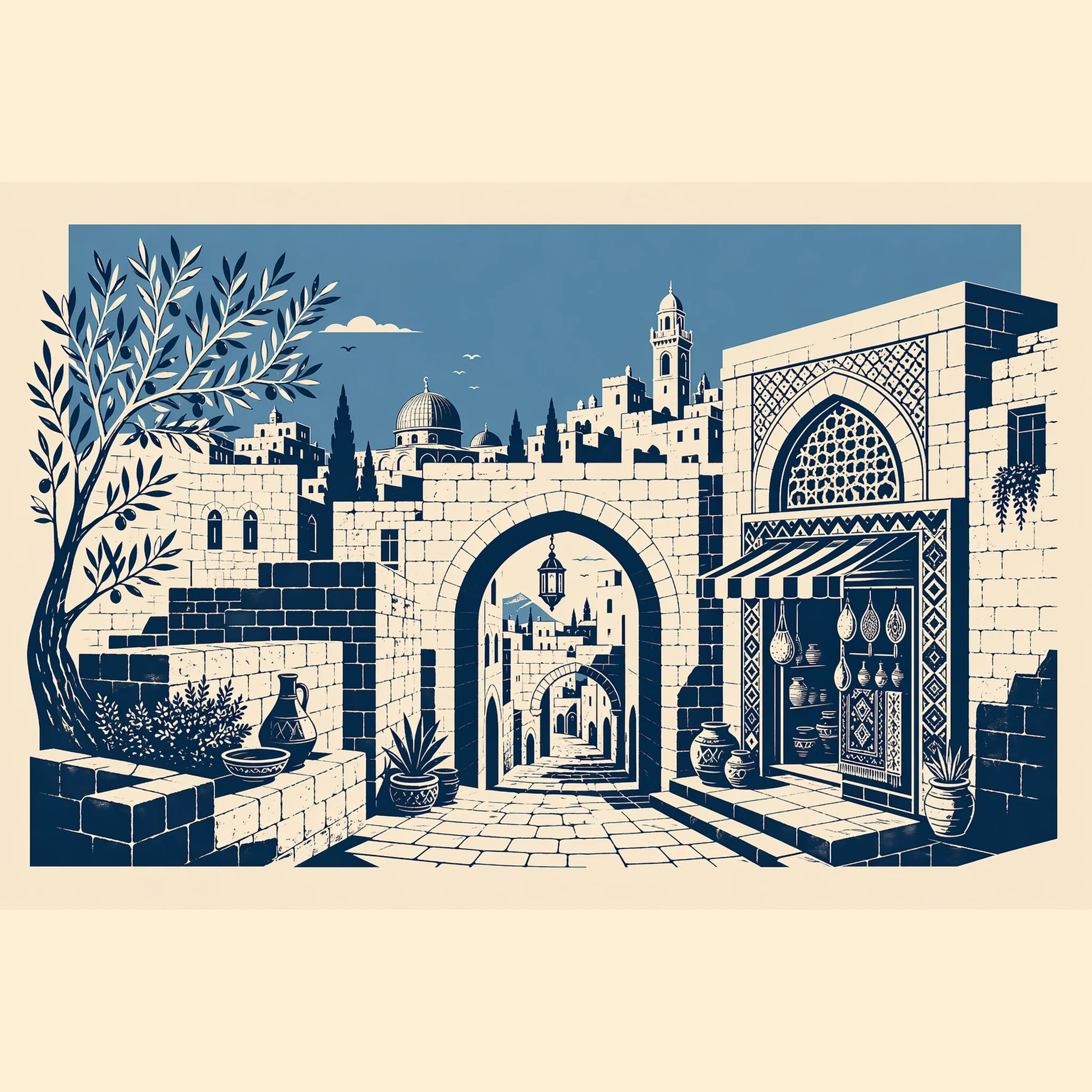
Palestinian Arabic is a Levantine branch with clear regional variation from Jerusalem, the north, Gaza, and rural areas. It blends familiar Levantine structure with vocabulary and pronunciation that strongly reflect local identity.
Signature features
- Pronunciation shifts by city and village (for example, ق may sound like q, g, or a glottal stop)
- Rich everyday vocabulary tied to food, land, and family life
- Widely heard across diaspora communities in the Gulf, Europe, and the Americas
Common phrases
Iraqi Arabic (Mesopotamian) carries layers of Aramaic, Turkish, and Persian influence. It's prized in poetry and song and is indispensable for work in Iraq, humanitarian projects, and cultural exchange with the Iraqi diaspora.
Signature features
- ق pronounced as g in many contexts
- Distinctive present-tense prefix da- (da-aktib — I am writing)
- Rich loanwords from Turkish, Persian, and Aramaic